Artificial Intelligence
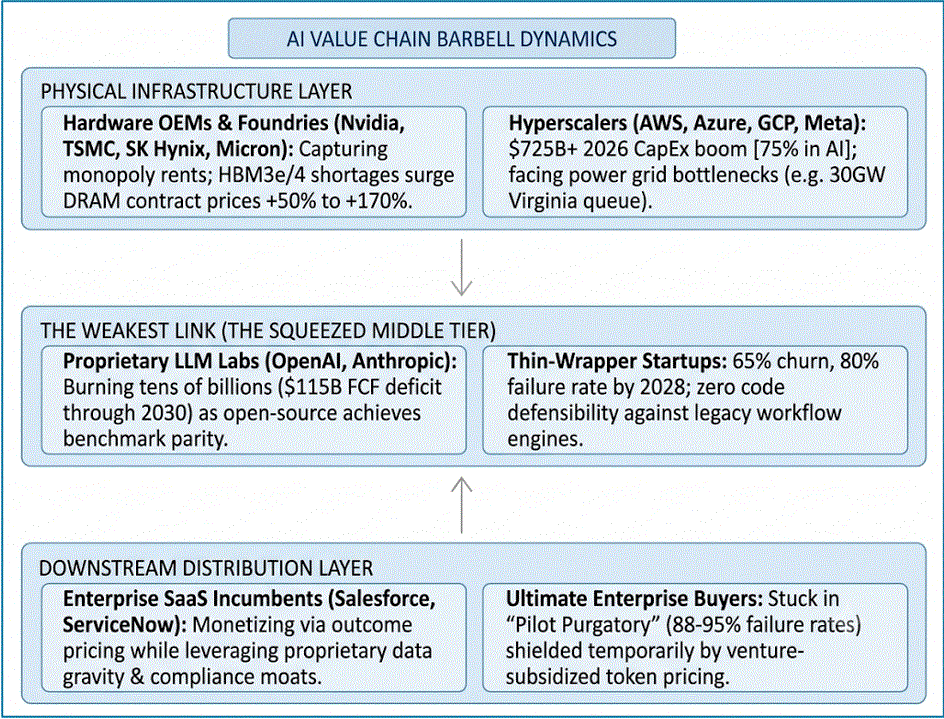
AI infrastructure investment is currently running materially ahead of directly observable end-user AI commercial revenue. The magnitude of the eventual “Capital Payback Gap” will depend on the degree and speed of AI adoption across enterprises and where economic value is captured across the AI value chain as a result of its “Barbell Polarization”.
“Barbell Polarization”
Capital and economic profit are concentrating at the physical foundation (silicon foundries, memory suppliers, cloud providers) and at the downstream distribution layer (legacy SaaS enterprise and vertical AI apps). Conversely, the middle layer (proprietary LLM developers, thin-wrapped AI apps) is trapped in a structural “Commoditization Squeeze”, pressured from above by non-negotiable compute and infrastructure costs and from below by open-source models.
A “DeepSeek Death Zone” formed by open-source models executing tasks 25x cheaper and reaching performance breakthroughs, combined with the “Physical Gridlock” from energy constraints starting to substantially delay new data centres, are accelerating the squeeze. This could lead to potential Geopolitical Sub-scenarios over 2027-28, from a US nationalization of burned-out closed-LLM labs, to dual US/China bans on respective LLMs, and/or to the surge of on-premise LLM deployment by enterprises on the back of new, powerful local hardware.
“Capital Payback Gap”
Hyperscaler total CapEx is running at $725bn+ by end-2026, while directly observable end-user AI commercial revenue is only $160-175bn p.a. At 60% gross margin, to generate a 15% unlevered project return (IRR) on the projected $5.0 Tr cumulative AI CapEx (2024-2030) and associated AI Opex, our model implies that AI vendors would need end-user commercial revenue of $450 Bn in 2026 and $2.4 Tr p.a. by 2030.
This creates a revenue gap of $275-290 Bn in 2026, which would widen to $2.0 Tr by 2030 unless enterprise AI revenue jumps c.14.3x over 2026 levels to produce $2.4 Tr p.a. For that, enterprises must escape “Pilot Purgatory” (c.95% of pilots not scaling to produce measurable impact) by (1) delivering massive productivity offsets/efficiency gains ($1.4 Tr) from the labour knowledge-workforce, and (2) IT vendors cannibalizing IT Services & BPO budgets into AI-driven SaaS expenditure ($1.0 Tr.). A lower $2.15 Tr p.a. revenue would yield 10% IRR, utility-like returns but still within a “Capacity Digestion” scenario.
Illustratively, if realized 2030 revenue were only $1.2 Tr p.a. (i.e. 50% of the baseline $2.4 Tr) the sensitivity matrix indicates severe value destruction, including an implied Project-IRR c. -25%.